A Guide for Virginian Homeowners
By Mark Adams | Mark Adams & Associates | eXp Realty
You own your home. You make the mortgage payments, pay the property taxes, maintain the house, and probably know exactly what your monthly payment is.
But here’s a question you may not know the answer to.
How do you legally own your home, and what happens to it if you die?
After 27 years in real estate, I’ve found that many homeowners understand their mortgage better than they understand their deed.
And the wording in that deed can make a significant difference when an owner dies, a relationship ends, or a family needs to settle an estate.
For this post I wanted you to understand why you need to know this information and where to find it.
Here’s What We’re Going to Cover
Whether you’ve owned your home for 20 years or you’re getting ready to purchase your first one, this information is worth understanding.
In this article, I’ll explain:
- How to find your recorded deed, even if you still have a mortgage or can’t locate your closing paperwork.
- The four common ways to own a home in Virginia, whether you’re purchasing alone, with a spouse, an unmarried partner, or a family member.
- What probate is, why it matters, and how certain ownership arrangements can help your loved ones avoid unnecessary legal proceedings and expenses.
- What happens when a sole homeowner dies, with or without a will.
- The difference between being on the deed and being on the mortgage, including whether one person can be responsible for the loan while two people own the home, or the other way around.
- What happens to your home and mortgage if an owner dies, and whether the surviving owner automatically receives the property.
- What a transfer-on-death deed is, and how it may help homeowners plan for the future.
- Whether you can change how you own your home after closing, and when you should speak with an attorney.
You don’t need to be a real estate expert to understand these things. But you should know where to find the answers, especially when those answers could affect your family and one of your largest financial assets.
Let’s start with something you can check today.
I’ve Already Purchased My Home. How Can I Find Out How I Own It?
The answer is in your recorded deed.
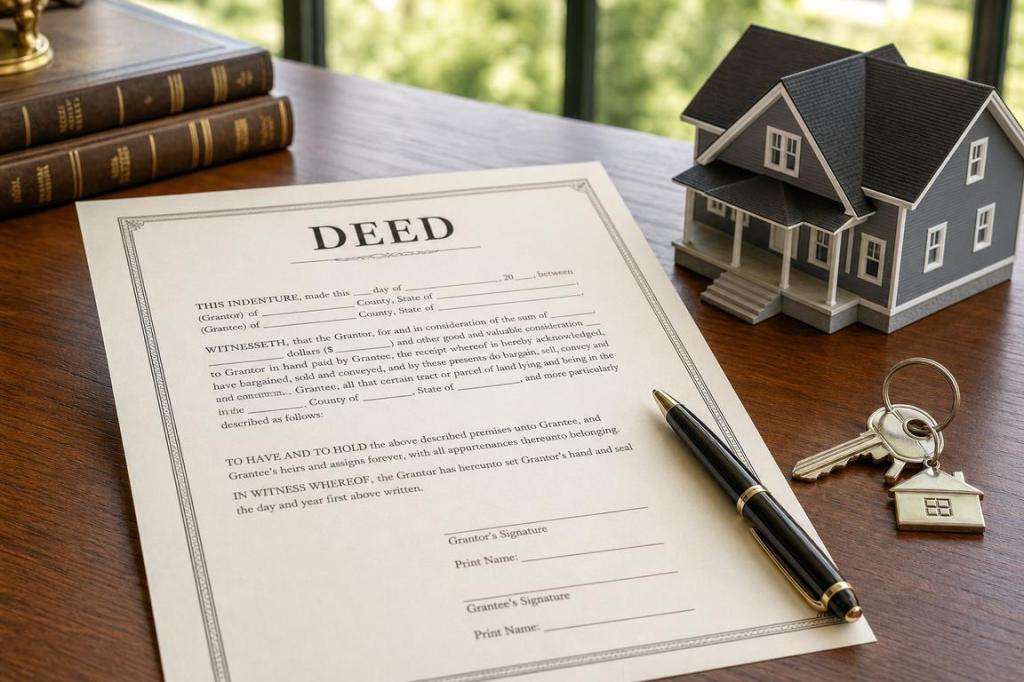
Your deed is the legal document that transferred ownership of the property to you. It identifies the owners and may include language describing how they hold title.
Where can I find a copy of my deed?
1. Check your closing paperwork.
When you purchased your home, the closing attorney or settlement company should have provided you with copies of your closing documents.
Look for something titled:
- General Warranty Deed
- Special Warranty Deed
- Deed of Bargain and Sale
These describe the type of deed used to transfer ownership. Within the deed, look for language such as tenants in common, joint tenants with right of survivorship, or tenants by the entirety.
2. Contact the attorney or settlement company that handled your closing.
If you can’t find your paperwork, contact the company that handled your purchase. They may be able to provide a copy of the recorded deed.
3. Contact your local Circuit Court Clerk’s Office.
In Virginia, deeds are recorded in the land records maintained by the Circuit Court Clerk in the city or county where the property is located.
For example, if you live in Henrico County, you would contact the Henrico County Circuit Court Clerk’s Office.
The same applies to Chesterfield, Hanover, Goochland, and the City of Richmond.
Ask the land records office how to obtain a copy of your most recently recorded deed. You may be able to access it online, request it in person, or obtain a copy for a small fee.
4. Check your local real estate tax records.
Your county or city’s online property records can help you identify whose names appear as owners.
However, tax records may not show whether you own the home with a right of survivorship.
For that, you’ll want to review the actual recorded deed.
What if I haven’t paid off my mortgage?
You still have a deed!
This is a common misunderstanding.
In Virginia, your deed is generally recorded when you purchase the home, even if you borrowed money to pay for it.
The lender doesn’t hold your deed until you pay off the mortgage.
Instead, the lender typically has a separate document called a deed of trust, which secures the loan against your property.
We’ll explain that distinction later.
One more thing: If you’ve changed ownership since purchasing the property, make sure you’re reviewing the most recent recorded deed or other relevant ownership documents, not just the original deed from closing.
Why Does the Way You Own Your Home Matter?
Because the way you hold title can determine what happens to your ownership interest when you die.
In some cases, your interest automatically transfers to the surviving owner.
In other cases, it may pass according to your will or Virginia inheritance laws and require probate or other estate-related paperwork.
And that’s where things can get complicated.
First, What Is Probate?
Probate is the legal process used to establish the validity of a deceased person’s will and, when necessary, administer and distribute their estate.
In Virginia, the Circuit Court Clerk generally handles the probate of wills and qualification of estate representatives. Court involvement may also be necessary when disputes arise.
When someone dies owning property in their name alone, or owning an interest without a right of survivorship, the property may need to be addressed through their estate.
That can involve:
- Establishing whether there is a valid will.
- Identifying the people legally entitled to inherit.
- Determining whether an executor or administrator needs to be appointed.
- Addressing debts, taxes, and other estate obligations.
- Completing paperwork needed to establish or transfer clear title.
Probate and estate administration can involve court or clerk’s fees, legal expenses, and delays. The process varies depending on the estate.
One important distinction: In Virginia, real estate can pass directly to heirs or beneficiaries at death under state law. That doesn’t necessarily mean the family can sell or refinance it immediately without additional documentation.
Here’s a simple example
Let’s say a homeowner dies and leaves the property to two adult children.
Both children may inherit ownership interests in the house.
But what if one wants to sell and the other wants to keep it?
The family may need legal assistance to resolve the disagreement or determine how to transfer clear title.
This is why understanding your ownership arrangement before something happens is so important.
Certain forms of ownership can allow a deceased owner’s interest to pass directly to someone else without probate of that interest.
Let’s look at four common ways to own a home in Virginia.
Four Common Ways to Own a Home in Virginia
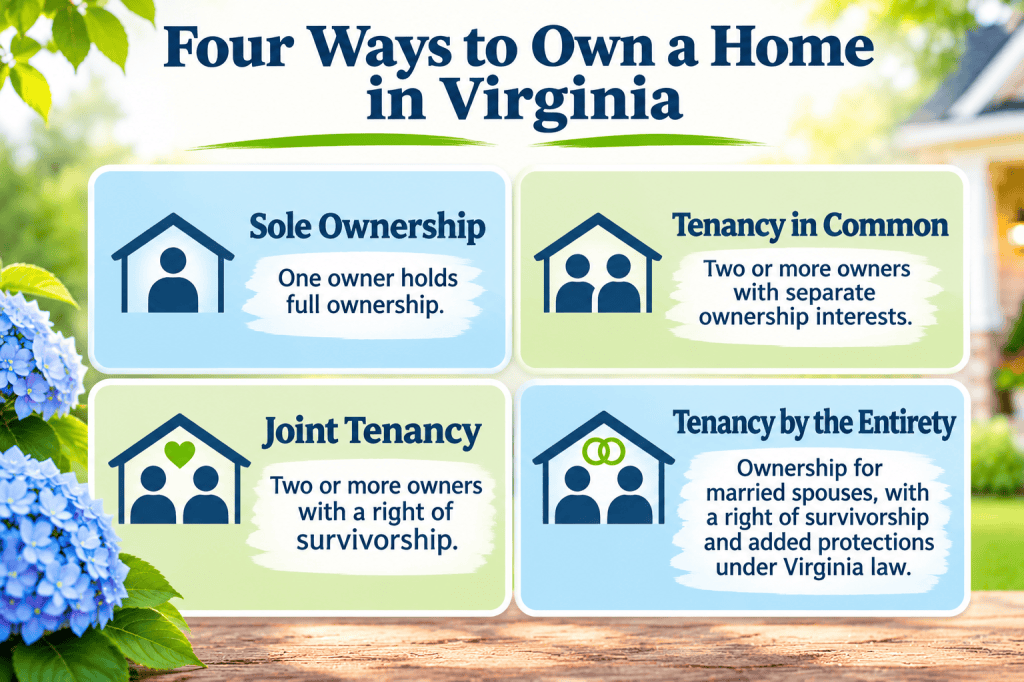
1. Sole Ownership (Ownership in Severalty)
What if you’re the only person who owns your home?
In Virginia, this is commonly called sole ownership, or ownership in severalty.
It simply means one person owns the property rather than sharing ownership with someone else.
Despite the terminology, you don’t have to be single to own property individually. A married person can also hold title in their name alone.
Who might benefit?
- Single people purchasing their first home.
- Divorced or widowed homeowners.
- Individuals who want to own property independently.
- Married individuals purchasing property in their own name, when appropriate for their circumstances.
But here’s something every sole homeowner should understand.
What happens to your home when you die?

If you have a will
Let’s say you’re single and own a home in Henrico County.
You have a will stating that your daughter should inherit the property.
When you die, the home generally passes to your daughter according to your will, assuming the will is valid and the property hasn’t been transferred through another arrangement.
However, the will generally must be admitted to probate to establish the transfer of ownership.
Remember, having a will does not automatically mean your family avoids probate.
Your heirs may still need to complete legal paperwork, address outstanding debts, and establish clear title.
If you don’t have a will
Now let’s say you own the same house but never prepared a will.
When you die, Virginia law determines who inherits the property.
This is called intestate succession.
If you’re unmarried, Virginia generally follows this order:
- Your children or their descendants.
- If you have no children or descendants, your parents.
- If your parents are deceased, your siblings or their descendants.
- If none of those relatives survive, other family members according to Virginia inheritance law.
For example, if you are unmarried and have two children, they may inherit the property together.
But what if one child wants to sell and the other wants to keep the house?
Now the family may have to work through disagreements over ownership, maintenance expenses, or selling the property.
And if the heirs can’t agree, legal proceedings may become necessary.
If the sole owner was married, a surviving spouse’s inheritance rights must also be considered. Virginia’s rules can be different when the deceased owner had children from another relationship.
Can a sole homeowner avoid probate?
Potentially, yes.
One option worth discussing with a Virginia estate-planning attorney is a transfer-on-death deed.
This document allows you to designate someone to receive your home when you die without making that person a current owner.
For example, you could name your daughter as the beneficiary while continuing to own and control your home during your lifetime.
When you die, the property generally transfers to her outside probate, provided the deed was properly prepared and recorded and remains effective.
Other estate-planning arrangements, including certain trusts, may also accomplish this.
My advice: If you’re the sole owner of your home, don’t assume that having a will is enough to make transferring the property simple for your family. Make sure you understand what will happen and whether probate can be avoided.
2. Tenancy in Common
Tenancy in common allows two or more people to own a property together while maintaining separate ownership interests.
Those interests don’t have to be equal. One person might own 60% and another 40%, depending on how ownership is established.
Who might benefit?
- Unmarried couples who want separate ownership interests.
- Siblings purchasing or inheriting property together.
- Friends purchasing investment property.
- Business partners investing in real estate.
The important distinction is that tenancy in common does not include an automatic right of survivorship.
If one owner dies, their interest passes according to their will or Virginia inheritance laws, potentially requiring estate administration.
Here’s an example
Two brothers purchase a house together, each owning 50%.
One brother dies and leaves his interest to his two children.
The surviving brother doesn’t automatically own the entire property. Instead, he may now own the home jointly with his deceased brother’s children.
That may have been exactly what everyone intended. But if it wasn’t, selling or refinancing the property could become complicated.
Depending on the circumstances, probate or additional legal proceedings may be necessary.
3. Joint Tenancy with Right of Survivorship
Joint tenancy with right of survivorship allows two or more people to own property together with a significant benefit.
When one owner dies, their interest generally passes automatically to the surviving joint owner or owners.
That transfer generally occurs without probate of the deceased owner’s interest.
This can be particularly beneficial for unmarried couples or family members who want the surviving owner to receive the property.
Here’s an example
An unmarried couple purchases a home together.
Both names are on the deed, and the deed specifically establishes joint tenancy with right of survivorship.
If one partner dies, the surviving partner generally becomes the sole owner without having to probate the deceased partner’s ownership interest.
That can save time, expense, and potential complications.
But there’s something important you should know
Joint tenancy with right of survivorship can be severed during the owners’ lifetimes.
What does that mean?
Let’s say two unmarried people purchase a home as joint tenants with right of survivorship.
Several years later, their relationship ends.
One owner decides to transfer their ownership interest to another person.
Under Virginia law, a joint tenant generally can convey their interest without the other joint tenant’s consent. If the transfer is legally effective, it can sever the joint tenancy as to that interest.
The result could be that the remaining original owner now owns the property as a tenant in common with someone they never intended to own a home with.
And the automatic right of survivorship would no longer apply to that transferred interest.
A joint tenant may also seek a court-ordered partition of the property, potentially resulting in a sale or division, depending on the circumstances.
This is one reason unmarried couples purchasing property together should consider a written co-ownership agreement addressing what happens if they separate, want to sell, or disagree.
Simply having a right of survivorship doesn’t guarantee that the ownership arrangement will remain unchanged forever.
4. Tenancy by the Entirety
Tenancy by the entirety is a form of ownership available to legally married couples in Virginia.
Like joint tenancy with right of survivorship, it allows the surviving spouse to automatically receive full ownership when the other spouse dies.
However, it provides additional protections.
Generally, neither spouse can independently sell or transfer the entire property or unilaterally sever the tenancy while the marriage continues.
Tenancy by the entirety also generally protects the property from creditors attempting to collect debts owed by only one spouse, although important exceptions apply.
Here’s an example
A married couple purchases a home together and takes title as tenants by the entirety.
Twenty years later, one spouse dies.
The surviving spouse automatically owns the property in full.
The deceased spouse’s ownership interest generally doesn’t need to go through probate.
The surviving spouse may still need to provide a death certificate or other documentation when selling or refinancing, but the ownership transfer itself occurs by operation of law.
Is this the best choice for married couples?
For many married couples purchasing a primary residence in Virginia, tenancy by the entirety is an option worth serious consideration.
But it’s not automatically appropriate for every situation.
Second marriages, blended families, estate-planning arrangements, creditor concerns, and other circumstances may affect the decision.
Also, being married and having both names on the deed does not automatically mean you own the home as tenants by the entirety in Virginia.
The deed must establish the appropriate form of ownership.
Which Type of Ownership Helps Avoid Probate?
Here’s how the four ownership arrangements compare.
| Ownership Type | Who Can Use It? | Automatic Survivorship? | What Happens When an Owner Dies? |
|---|---|---|---|
| Sole Ownership | One individual, married or unmarried | No | Passes by will or Virginia inheritance law, unless another valid transfer arrangement applies |
| Tenancy in Common | Two or more owners | No | Deceased owner’s interest passes to heirs or beneficiaries |
| Joint Tenancy with Right of Survivorship | Two or more owners | Yes | Deceased owner’s interest generally passes automatically to surviving joint owners |
| Tenancy by the Entirety | Married spouses | Yes | Surviving spouse generally becomes sole owner automatically |
If your primary concern is making sure the surviving owner receives the home without having to probate the deceased owner’s interest, the right of survivorship is particularly important.
For sole homeowners, a transfer-on-death deed or another estate-planning arrangement may help achieve a similar goal.
However, avoiding probate doesn’t necessarily eliminate all expenses, paperwork, debts, or legal obligations.
And avoiding probate isn’t always the only consideration when deciding how to hold title.
Here’s Where People Get Confused: The Deed, Promissory Note, and Deed of Trust
When you purchase a home with financing, you generally encounter three different documents that serve very different purposes.
The deed: Who owns the home?
The deed transfers ownership from the seller to the buyer.
It identifies the new owners and contains the language establishing how they hold title.
The promissory note: Who owes the money?
A promissory note is a written promise to repay the mortgage loan.
It identifies the borrower or borrowers who are personally responsible for repayment.
It generally outlines the amount borrowed, interest rate, payment terms, and other obligations.
For example, if you borrow $350,000 to purchase a home, the promissory note is your written agreement to repay that $350,000 under the loan’s terms.
The deed of trust: What secures the loan?
In Virginia, a deed of trust is commonly used to secure a mortgage loan.
It places a lien on the property, giving the lender rights against the real estate if the loan isn’t repaid according to its terms.
Here’s the distinction:
- The deed establishes ownership.
- The promissory note establishes the borrower’s repayment obligation.
- The deed of trust secures the loan with the property.
These documents are related, but they don’t accomplish the same thing.
Can One Spouse Be on the Mortgage Loan While Both Spouses Own the Home?
Yes.
Let’s say a married couple purchases a $500,000 home.
The husband qualifies for the mortgage using only his income and credit.
Both husband and wife are listed on the deed as tenants by the entirety.
Both spouses own the property, but only the husband signs the promissory note and becomes personally responsible for repaying the loan.
The wife will generally still need to sign the deed of trust because her ownership interest is part of the collateral securing the mortgage.
If the husband dies, the wife generally becomes the sole owner through survivorship.
However, the mortgage balance doesn’t disappear. The loan remains secured by the property.
Can Two People Be Responsible for the Mortgage While Only One Owns the Home?
Yes, depending on the financing arrangement.
For example, a parent might agree to co-sign a mortgage to help an adult child qualify.
The child could be the only person on the deed, while both the parent and child are responsible for the promissory note.
The parent has a financial obligation but doesn’t automatically receive an ownership interest.
This is why it’s so important to distinguish between being a borrower and being an owner.
You can owe money on a house without owning it, and you can own a house without being personally responsible for the mortgage note.
Specific requirements vary by lender and loan program.
What Happens to the Mortgage When an Owner Dies?
The death of a borrower doesn’t automatically eliminate the mortgage.
Even if the surviving owner receives the property through a right of survivorship, the lender’s lien generally remains.
The surviving owner should contact the mortgage servicer to understand payment responsibilities, servicing rights, and available options.
In many situations, federal law provides protections for qualifying successors who inherit property, but the specific circumstances matter.
Ownership and financing are two separate issues.
What Is a Transfer-on-Death Deed?
This is another ownership-related document many Virginia homeowners may not know about.
Virginia has permitted transfer-on-death deeds since 2013.
A transfer-on-death deed allows a property owner to name a beneficiary who will receive the property when the owner dies.
The beneficiary doesn’t become an owner immediately.
The current owner generally retains control during their lifetime and can revoke the transfer-on-death deed.
Here’s an example
A widowed homeowner owns a house in Henrico County.
She wants her daughter to inherit the property when she dies, but she doesn’t want to make her daughter a co-owner today.
With a properly prepared and recorded transfer-on-death deed, she may be able to designate her daughter as the beneficiary.
When the homeowner dies, the property transfers according to the deed without probate of that ownership interest, subject to applicable law and existing obligations.
Why haven’t I heard about this at closing?
A transfer-on-death deed is primarily an estate-planning tool rather than a standard part of purchasing a home.
Your closing attorney may discuss how you want to hold title, but that doesn’t necessarily mean they will conduct a complete estate-planning consultation.
Transfer-on-death deeds generally aren’t required to be discussed at a routine residential closing.
If you’re interested in one, consult a Virginia attorney who handles estate planning or real estate law.
The deed must meet specific legal requirements and be recorded before the owner’s death.
It also doesn’t eliminate mortgages, liens, or all potential claims against the property.
Can You Change How You Own Your Home After Closing?
Often, yes.
But it isn’t as simple as changing a name on your tax bill.
Changing ownership may require a new deed prepared and recorded by an attorney.
Depending on the circumstances, it can also have consequences involving:
- Mortgage documents and lender requirements.
- Gift taxes or other tax considerations.
- Creditor protections.
- Divorce or separation.
- Estate planning and inheritance.
- The rights of existing co-owners.
If you discover that your current ownership arrangement doesn’t reflect your intentions, don’t try to fix it by preparing a deed yourself without legal guidance.
A Virginia attorney can explain the appropriate way to make a change.
My Advice After 27 Years in Real Estate
Most homeowners remember the interest rate they received when they purchased their house.
Far fewer remember the exact language in their deed.
But that language can have significant consequences for the people they care about.
Whether you’re married, unmarried, buying with a family member, or purchasing a home on your own, take the time to understand how your ownership is established.
If you already own a home, locate your recorded deed and review it.
And if you don’t understand the language, ask a Virginia real estate or estate-planning attorney to explain it.
The goal isn’t simply to avoid probate. It’s to make sure your home passes to the people you intend, in the way you intend, with as few unnecessary complications as possible.
Buying a home is a major investment. Understanding how you own it is just as important as understanding how you’re paying for it.
Thinking About Buying or Selling a Home?
We love helping people make their next move! If you or someone you know is thinking about buying or selling a home, we’d appreciate the opportunity to help. Referrals from friends, family, and readers like you mean a lot to us.
Mark Adams
Mark Adams & Associates
eXp Realty
office@markadamsteam.com
804-237-8585
Realtors by Day | Dog Lover 24/7
This article is intended for general educational purposes and does not constitute legal, tax, or financial advice. Property ownership, inheritance, survivorship, creditor rights, and mortgage obligations depend on individual circumstances and the language of the recorded documents. Consult a qualified Virginia attorney and appropriate financial professionals before making changes.







Leave a Reply